

How do you make money as a SaaS founder in 2026 and beyond?
I’ve been thinking about this a lot lately. AI is eating into entire categories of SaaS, the cost of building software is collapsing, and many of the opportunities that worked for indie hackers and software entrepreneurs over the last decade suddenly feel a lot less attractive.
So I’ve been asking myself a simple question: if I were starting from scratch today, what would I build?
I think I found one possible answer in an unlikely place: the explosive growth of OpenClaw, and more recently, Instinct.
OpenClaw validated the capability. Instinct productised the behaviour.
That distinction matters. OpenClaw went from a weekend project to more than 100,000 GitHub stars in roughly two months, and its repo has since grown to around 391,000 stars. That is extraordinary evidence that people want AI that does things, not merely one that answers questions.
OpenClaw proved the demand among technically capable early adopters. The problem was that it remained far too fiddly and technical for the average person to set up. Instinct then removed much of that friction with an explicit philosophy of “no new interfaces”: instead of learning another piece of software, you text it, send it a voice message or call it, while the agent operates phones and computers on your behalf.
In many ways, Instinct is OpenClaw for normal people.
I think there is a much bigger idea hiding inside that observation. Instinct may be an early indication of where SaaS is going, and it gives us five principles that are highly relevant to the next generation of software.
1. The interface recedes
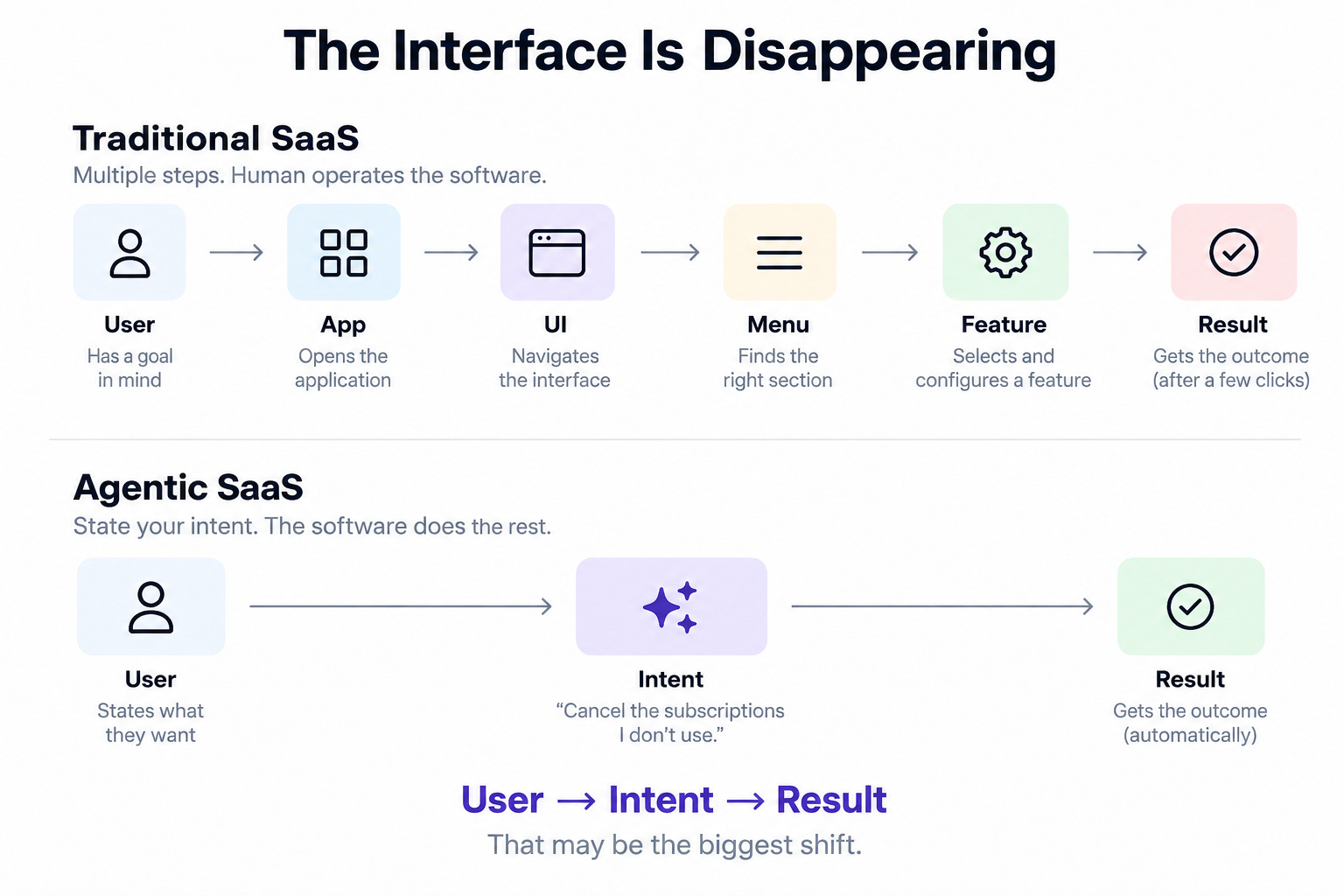
Traditional SaaS works something like this:
User → App → UI → Menu → Feature → Result
Agentic SaaS increasingly looks like:
User → Intent → Result
That may be the biggest shift. Instinct doesn’t require you to learn a dashboard or figure out which feature performs the task you have in mind. You communicate using something humans already understand - natural language.
“Cancel the subscriptions I don’t use.”
The software figures out the workflow.
I don’t think this means dashboards, CRMs or conventional software interfaces disappear. Businesses still need systems of record. They need somewhere to store customers, transactions, communications, permissions and history, while managers still need dashboards for oversight, analytics, configuration and exception handling.
What changes is the starting point.
Today, the human operates the system of record. Tomorrow, the agent increasingly operates it on the human’s behalf.
Human → Agent → System of Record → Action
The CRM remains. The difference is that you may spend dramatically less time clicking around inside it.
So I think we’re moving from software as a tool toward software as a worker, with natural language, voice and notifications becoming the primary interface while the traditional application increasingly becomes the underlying system of record and control plane.
2. Distribution happens through existing behaviour
This is probably one of Instinct’s smartest product decisions. It doesn’t require users to develop the habit of opening yet another application; instead, it inserts itself into a behaviour people already perform dozens of times every day: messaging.
Instinct describes this as “no new interfaces,” and I think that idea extends well beyond personal assistants. It suggests a very important product rule for the next generation of SaaS:
Don’t create a destination if you can become part of an existing workflow.
The future SaaS product might live primarily inside iMessage, WhatsApp, Slack, Teams, email or voice rather than requiring users to constantly return to its own interface. The standalone application doesn’t disappear; it becomes the control plane - the place you go to inspect data, configure the system, view analytics, manage permissions or handle exceptions.
But it doesn’t necessarily need to be where the work starts.
That reduction in friction also has enormous implications for distribution. A sophisticated product that takes an hour to install and configure is limited to people motivated enough to cross that barrier. Take the same underlying capability and make it accessible by sending a message, and the addressable market expands dramatically.
OpenClaw proved the capability among early adopters. Instinct made the behaviour accessible to everyone else.
3. Vertical agents will beat generic agents at specific jobs
This is where I think the “Instinct for X” opportunity becomes particularly interesting.
Instinct is horizontal: it is essentially an AI personal assistant for normal people. But there are potentially hundreds of vertical versions of the same idea waiting to be built.
Imagine an Instinct for golf coaches. The coach sends a voice note:
“Follow up with everyone who had a lesson this month but hasn’t booked another one.”
The agent checks the CRM, identifies the golfers, writes the messages, sends them, handles responses, books lessons and potentially collects payment.
Or an Instinct for longevity clinics:
“Which patients are overdue for bloodwork? Contact them and get them booked in.”
The agent checks patient records, identifies the relevant patients, contacts them, books tests, updates the system of record and prepares a briefing for the clinician.
Or an Instinct for real-estate agents:
“Follow up with everyone who viewed 18 Orchard Road and tell me who’s genuinely interested.”
Or an Instinct for small-business owners:
“Chase every overdue invoice.”
The underlying CRM, practice-management system or accounting platform remains important. In fact, it becomes even more important because the agent needs reliable structured data from which to operate. What changes is that the human no longer needs to manually operate every part of it.
The opportunity isn’t necessarily to build a better CRM.
It’s to build the worker that operates the CRM.
That distinction is enormous.
4. SaaS moves from seats to outcomes
Traditional SaaS economics are largely built around seats - $49 per user per month, for example - because humans operate the software. But when agents increasingly perform the work, seat-based pricing starts to make less sense.
Instead, pricing can naturally move toward completed jobs, leads generated, appointments booked, transactions processed, agents deployed or even a percentage of the economic value created.
This could potentially expand the TAM for software.
A small business owner might refuse to pay $300 per month for another CRM that creates more work for them, but happily pay $1,000 per month for an AI receptionist that answers every enquiry, follows up every lead, books customers and keeps the CRM updated automatically.
The comparison has changed.
They’re no longer comparing the product with software.
They’re comparing it with labour.
That creates a dramatically larger willingness-to-pay anchor and potentially changes the economics of entire SaaS categories.
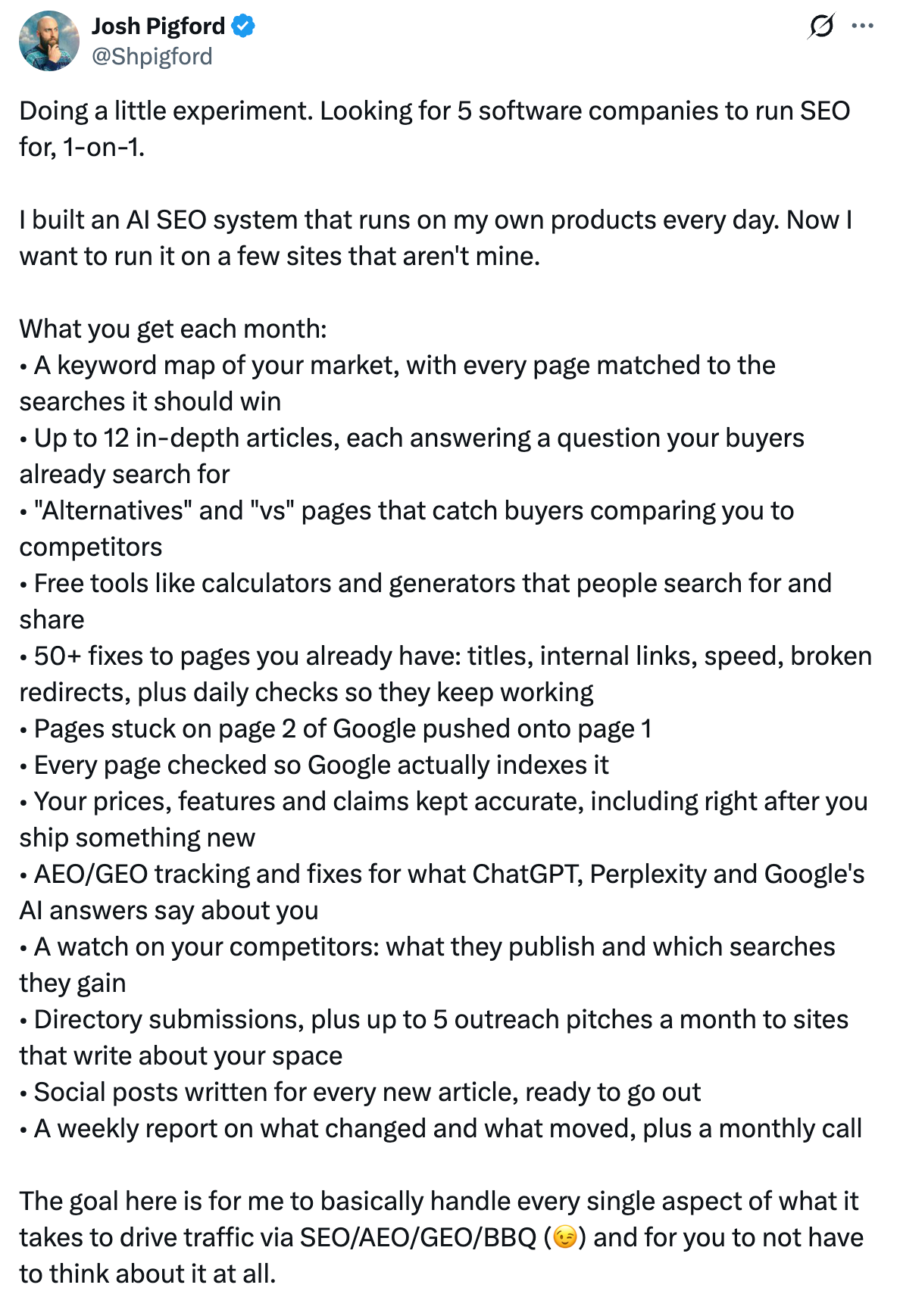
Here’s a very recent example: Josh Pigford, a serial indie hacker generated nearly $400,000 ARR in 10 days after launching an AI SEO product charging $1,500/mo.


These are the outcomes the service promises:
Pretty neat.
5. Memory + agency creates the real moat
The first interaction with an AI agent isn’t necessarily remarkable. The 500th interaction potentially is.
An agent becomes increasingly useful as it learns who you know, what you care about, how you communicate, what you buy, what you ignore, what you’re working on, your routines and your preferences. More importantly, unlike a conventional database that merely stores this information, the agent can act on that context.
That creates a different moat from traditional SaaS.
It isn’t simply:
Data → Dashboard
It’s:
Context → Memory → Judgment → Action → Feedback → Better Context
Over time, switching costs therefore become partly behavioural. Your agent effectively becomes something closer to an employee or personal assistant who has worked alongside you for years and understands how you operate.
This also creates one of the biggest challenges for this category. The deeper the context and the greater the agency, the more important trust, permissions and security become. Giving software access to your calendar is one thing; giving an autonomous agent permission to send messages, make purchases, access financial information or operate business systems on your behalf is another.
The companies that solve that trust problem may have an enormous advantage.
What this means for SaaS
I would summarise the evolution something like this:
SaaS 1.0 - System of Record
Software stores the information.
↓
SaaS 2.0 - System of Engagement
Software helps humans interact with the information.
↓
SaaS 3.0 - Copilot
AI tells humans what they should do.
↓
SaaS 4.0 - Agent
AI does the work when instructed.
↓
SaaS 5.0 - Autonomous Worker
AI notices that something needs doing before you ask, does most of it, updates the system of record and involves you only when judgment or permission is required.
That last transition is particularly important. A great agent shouldn’t require 50 prompts a day.
Imagine waking up and receiving this message:
“Three customers were at risk of churning. I contacted all three. Two issues are resolved. The third wants a $1,200 refund, so I need your approval.”
The underlying CRM might contain all the customer records, communication history and churn-risk data. There might still be an excellent dashboard where you can inspect all of it.
But you didn’t have to open it.
That’s the shift.
The “Instinct for X” opportunity
This creates what I think could become an interesting framework for finding the next generation of SaaS companies.
Instead of only asking:
“What new software can we build?”
Ask:
“What complicated software or human workflow has already been validated, but is still too difficult, repetitive or time-consuming for ordinary people to operate?”
Then look for the OpenClaw → Instinct transformation:
Powerful → Simple
Technical → Conversational
Reactive → Proactive
Software → Worker
Dashboard-first → Messaging/voice-first
Features → Outcomes
There are potentially hundreds of markets where this applies, and importantly, founders don’t necessarily need to invent entirely new technical capabilities to capture them. The underlying building blocks - frontier models, computer use, voice, memory, payments, messaging and APIs - are increasingly becoming commodities.
The product innovation moves up a level.
Which worker are you replacing or augmenting? Who is it for? What context does it understand? What systems can it operate? What actions can it take? Where does the user already communicate with it?
And perhaps most importantly:
What existing product or workflow has already proven that people desperately want the capability, but remains too complicated for the mass market?
OpenClaw validated one such capability. Instinct packaged it for everyone else.
I suspect one of the more interesting startup opportunities over the next few years will be finding the next “Instinct for X.”